Senge opens The Fifth Discipline with a claim that struck me as almost radical the first time I read it: the organisations that will truly excel in the future will be the organisations that discover how to tap people's commitment and capacity to learn at all levels of the organisation.
Not the organisations with the most capital. Not the ones with the most talented individuals. Not the ones with the most advanced technology or the most efficient processes. The ones that learn.
This felt almost insufficiently grand the first time I read it. Of course learning is important. Everyone knows learning is important. But Senge means something precise by this — something that most organisations, and almost all African startups I have encountered, do not do. He means the cultivation of five specific disciplines that together produce an organisation that can update its model of reality faster than its environment is changing, adapt its strategy before the evidence of failure is undeniable, and generate commitment from its people that cannot be manufactured by incentives alone.
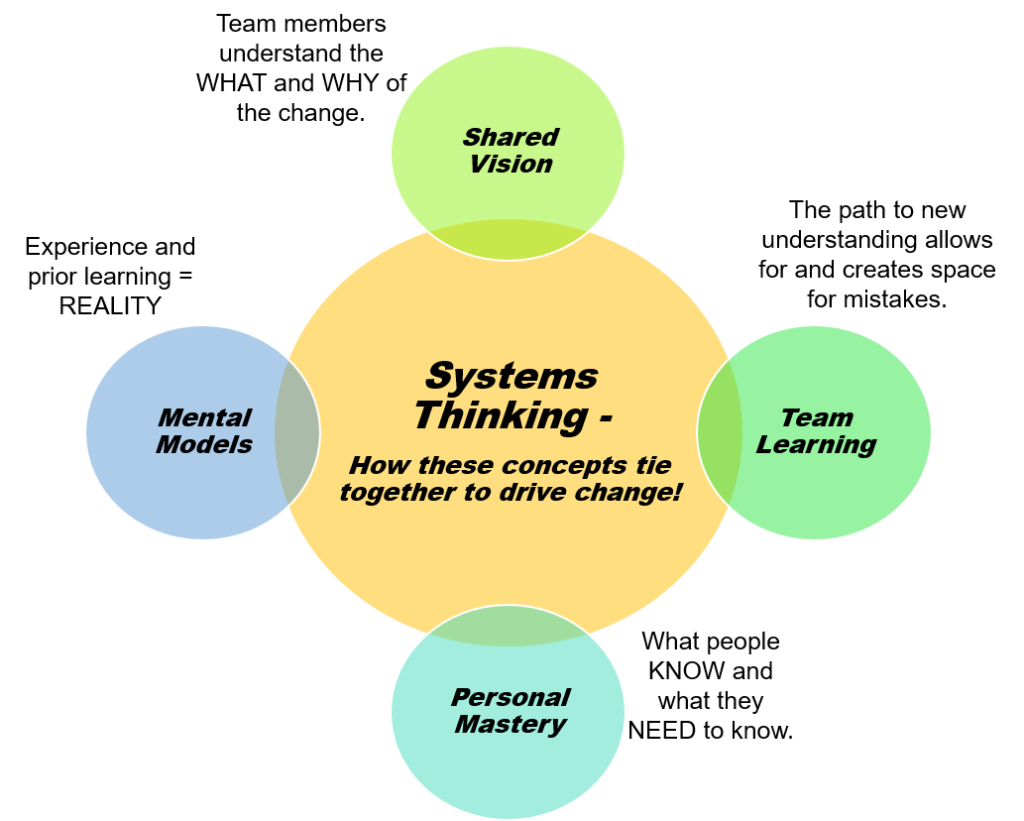
These five disciplines — personal mastery, mental models, shared vision, team learning, and systems thinking (the fifth discipline, the one that integrates all the others) — are not a checklist. They are a set of practices that have to be built into the organisation's operating system, not bolted on as culture initiatives. Let me walk through each briefly, and then explain what they mean for building in Africa.
Personal mastery.
Senge describes personal mastery as the discipline of continually clarifying and deepening our personal vision, of focusing our energies, of developing patience, and of seeing reality objectively. It is the foundation on which everything else is built, because an organisation cannot learn faster than its individuals can.
For African founders, personal mastery has a specific texture. It means developing the discipline to distinguish between what you know and what you believe, between what is happening and what you fear is happening, between the evidence in front of you and the story you are telling yourself about that evidence. It means maintaining a clear, honest picture of where you are while holding a vision of where you are going — what Senge calls "creative tension," the gap between current reality and desired future that generates the energy for genuine movement rather than anxious activity.
The creative tension is not the same as stress. Stress is what happens when the gap feels threatening. Creative tension is what happens when the gap feels like an invitation. Building an organisation with personal mastery at its foundation requires founders who can inhabit the creative tension long enough to use it — who can sit with an honest picture of current reality, including its uncomfortable parts, without collapsing either into denial ("things are fine") or despair ("it is hopeless").
In the specific context of building in Africa, where the honest picture includes infrastructure failures, market immaturity, talent scarcity, and capital constraints, this discipline is genuinely difficult and genuinely essential. The founders who build something lasting are not the ones who are optimistic about these constraints. They are the ones who see them clearly and find the path through them anyway.
Team learning.
Senge distinguishes between discussion and dialogue — two very different communication practices that produce very different organisational outcomes. Discussion is the familiar mode: positions are advocated, defended, and evaluated. Someone wins. A decision is made. In discussion, the quality of the outcome is determined by the quality of the best position in the room.
Dialogue is different. In genuine dialogue — which Senge describes as thinking together, not competing — the group accesses a quality of intelligence that none of its members could produce alone. Assumptions are surfaced and examined collectively. The maps that different people carry become visible. The model of reality the group is working with becomes richer and more accurate than any individual's.
Most African startup teams I know operate almost exclusively in discussion mode. The founder advocates for a position, the team pushes back or endorses, and a decision is made. The team is a decision mechanism, not a learning mechanism. This is efficient in the short run and catastrophically limiting in the long run, because the decisions are only as good as the model of reality in the founder's head.
Team learning — genuine dialogue — produces decisions that are as good as the collective intelligence of the group, which is almost always better than the individual intelligence of the founder alone. It also produces commitment: when people have genuinely contributed to forming a position rather than being told what the position is, they carry it with a different quality of ownership.
Building dialogue into a startup team requires explicit practice, because the default is discussion. It requires the founder to genuinely ask questions rather than just seeking validation. It requires the creation of spaces — structured meetings, regular retrospectives, design reviews — where the purpose is genuine inquiry rather than decision-making.
Shared vision.
Senge distinguishes sharply between a shared vision and a common vision. A common vision is one that everyone in the organisation knows. A shared vision is one that people genuinely hold as their own — that shapes their daily choices and sustains their commitment through difficulty not because they were told to care about it, but because it genuinely matters to them.
The distinction is not rhetorical. It is structural. An organisation with a common vision has an alignment problem that will surface the moment external pressure makes compliance costly. An organisation with a shared vision has an energy source that compounds over time — people invest more than is asked of them because they are investing in something they genuinely believe in.
Building a shared vision requires founders to do something that is uncomfortable: to genuinely engage their team in shaping the vision, not just communicating it. To take seriously the possibility that what their team members care about is as important to the company's direction as what the founder cares about. To recognise that the vision belongs to everyone who carries it, not just to the person who originated it.
In African startup culture, there is often a founder-centred, hierarchical vision model: the founder sees clearly, everyone else follows. This model can produce short-term compliance and long-term fragility. The team that is executing the founder's vision, rather than their own shared one, will not push back when they see problems, will not go beyond what is asked, and will not stay when better-compensating alternatives emerge. The vision that is genuinely shared — that a team has genuinely helped create — generates the commitment that cannot be hired or incentivised.
The learning organisation in African markets.
I want to make a specific argument about why learning organisations are not just valuable but existentially necessary for African startups, in a way that they are not quite for companies operating in more stable environments.
Everything in an African market is changing simultaneously. Consumer behaviour is changing as smartphone penetration deepens and new demographics come online. Regulatory frameworks are changing as governments try to balance innovation and protection. Capital markets are changing as global VC interest in Africa fluctuates with the macro environment. Talent markets are changing as more trained engineers graduate and as remote work opens global competition for that talent. Infrastructure is changing — power, connectivity, logistics — at a pace that makes three-year-old business models potentially obsolete.
In this environment, a company whose learning is slower than the rate of environmental change will always be reacting to conditions that no longer fully apply. The strategy that was optimised for the environment of two years ago is being executed in an environment that has already moved on.
The companies that survive this — and that eventually compound into the institutions that define their industries — are the ones whose internal learning loop is faster than their environment's rate of change. Not the ones with the most capital (which can accelerate the wrong direction faster). Not the ones with the most talent (which is necessary but not sufficient). The ones that see most clearly, adapt most accurately, and update their model of reality most reliably.
That is a learning organisation. And in Africa, that is the only kind of organisation that deserves to be building for the long term.
This is Post 6 of 7 in the Systems Founder series.